
Who the f*ck am I supposed to trust??

I’m a child of the internet.
I LOVE all the information that’s literally available at our fingertips.
(Yes, I DO need to know what a vole is at a moment’s notice. You’re welcome).
Butttt even I’ll admit that the unlimited vault of information we have access to isn’t always helpful.
Have a cough? Google it and determine that in fact you have cancer.
Want to try a new diet? There are literally thousands to choose from.
So how are you supposed to know what to trust?
Especially when it comes to your mental health (kind of an important subject, ya know?).
Generally, I recommend consulting the scientific literature - is there research that supports it?
But science is no perfect field either. There are plenty of flawed studies and biased research.
So seriously, what does that mean we’re supposed to do??
WHO CAN I TRUST?? HOW DO I KNOW WHAT’S RIGHT??

It’s important to feel confident in whatever path you’re choosing. If you don’t believe that it’s going to help you it likely won’t.
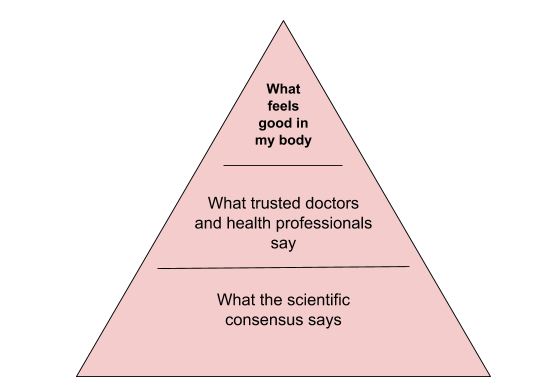
Which is why when it comes to MY body and mind (and what I recommend to my clients) I use a three-step process.
-
What does the research say? Is there more than one study on it?
Research isn't perfect. It pays to look at the actual studies to understand what’s really being investigated. An important note here - no single study PROVES anything. It takes many studies over many years for the scientific community to come to a ‘conclusion’ on a subject. Individual studies are VERY helpful but interpret them wisely. Just because one study done on mice says that alcohol improves cognition doesn’t mean you should start making weekend benders a regular part of your routine.
-
What do health professionals that I trust say on the subject?
Most people don’t go to school to learn how to interpret scholarly articles. And that's OK. If research papers make your eyes glaze over, then it’s always a good idea to identify a few health professionals whose opinions you trust.
-
How does it feel in your body?
Ultimately, it doesn't matter what the research or professionals say, you’ve got to figure out how it feels for YOU in your body. So experiment! Try new ways of eating, check out a new exercise class or give meditation a whirl - ya really won’t know until you try.
Let’s try this method out with a real-world example!
There is a growing body of evidence suggesting that food has a significant effect on mood. But researchers are still working to investigate the exact pathways that are affected.
A recent study looked at data from 843 adolescents (that’s a decent sample size!).
Participants of the study completed a questionnaire assessing their food and nutrition habits when they were 14 years old. Three years later participants followed up and also completed a mental health survey.
The researchers classified participant’s dietary habits as ‘Western’ (i.e., unhealthy) - high in red-meat consumption, take out, processed foods and sugar or ‘Healthy’ - high in fruit, vegetables, fish, and whole grains.
They found that following a ‘Western’ diet at 14 years old was associated with a higher BMI, more inflammatory markers in the blood, and greater instances of depression and mental health problems.
On the other hand, a ‘healthy’ diet was associated with lower BMI and inflammation levels.
No stand-alone study PROVES anything.
However, this study adds to the existing body of research and suggests that a diet rich in processed foods and sugars is associated with increased depression and mental health problems, likely due to increased inflammation.
According to the study, it’s possible that eating well could protect against depression.
So, if you’ve been wondering if food could be affecting your mood at all...
Step 1) Read the actual study that I linked.
Step 2) Re-read my explanation of it and maybe google around to see what other trusted sources are saying on the subject
Step 3) Decide for yourself. What do you think? Have you noticed that food has an effect on your mood? Would you be willing to experiment? Let me know in the comments!