
How Food Ruins Your Mood: The Gut-Brain Connection
We primarily think of the gut as being vital for digestion - what else is going to break down food into the nutrients our bodies need to survive?
But you’ve also experienced the sensation of butterflies fluttering when you’re nervous, a gut-wrenching feeling when you realize you left the flat iron on, or your stomach dropping when you receive bad news.
So what gives? Is our gut also responsible for our mood? Or does our mood affect our stomachs?
There is a whole body of emerging evidence indicating that the gut is responsible for far more than digestion and slight feelings of nervousness.
In connection with our brain it greatly impacts our mental state and plays a key role in certain diseases throughout the body. So much so that it’s referred to as the body’s “second brain.”
The more we learn about the intricacies of the vagus nerve, the enteric nervous system, and the amazing influence your gut microbes can have, it's no wonder that what you eat feeds not only your body but can directly affect your brain.
This is REAL cool (but not too surprising).
Why? Let’s start by looking at exactly what we mean by the "gut-brain connection"?
It’s complex, and to be honest, we’re still learning lots about it!
There seem to be multiple things working together. Things like:
- The vagus nerve that links the gut directly to the brain;
- The “enteric nervous system” (A.K.A. “second brain) that helps the complex intricacies of digestion flow with little to no involvement from the actual brain and the massive amount of neurotransmitters produced by the gut;
- The huge part of the immune system that is in the gut, but can travel throughout the body;
- The interactions and messages sent by the gut microbes.
I’ll briefly touch on these areas, and end off with a tastyyy recipe you can use to fuel your gut and boost your mood.
THE VAGUS NERVE
The vagus nerve, the longest nerve in the human body, runs from the deepest part of the gut all the way up to the brain.
We can think of it as a communication superhighway of connectivity between your gut and brain.
Now interestingly, about 80-90% of the communication along this highway goes from the gut to the brain - not the other way around!
More and more studies are indicating that gut signals travel from the stomach to the brain to modulate feelings such as fear, anxiety, stress, depression, etc. It’s becoming clear that the stomach certainly has a say in how we respond to fear and other emotions.
THE ENTERIC NERVOUS SYSTEM AND NEUROTRANSMITTERS
Ready for another cool fact about your gut?
The enteric nervous system of the gut contains over 100 million neurons, that’s more than the spinal cord!
That's why it's referred to as the "second brain."
Which makes sense - controlling the complex process of digestion (i.e. digestive enzymes, absorption of nutrients, the flow of food, etc.) should probably be done pretty smartly.
How do these nerves speak to each other, and to other cells? By chemical messengers called "neurotransmitters."
In fact, many of the neurotransmitters that have a strong effect on our mood are made in the gut! A whopping 95% of the body’s serotonin is made in your gut, not in your brain!
So it’s little wonder that antidepressant medications that increase serotonin levels often also result in bowel and digestive issues and vice versa - too much serotonin in our intestines can result in irritable bowel syndrome.
THE IMMUNE SYSTEM OF THE GUT
Because eating and drinking is a huge portal where disease-causing critters can get into your body, it makes total sense that much of our defense system would be located there too, right?
Yep, SEVENTY-FIVE PERCENT of our immune system is in our gut!
The funny thing about immune cells is that they can move throughout the entire body and cause inflammation just about anywhere.
When activated by something in the gut, they can potentially wreak havoc anywhere in the body. Including the potential to cause inflammation in the brain, muscles, and other organs.
GUT MICROBES
Your friendly neighborhood gut residents. You have billions of those little guys happily living in your gut.
And they do amazing things like help you digest certain foods, make certain vitamins, and even help regulate inflammation!
But more and more evidence is showing that changes in your gut microbiota can impact your mood, and even other, more serious, mental health issues. Research is indicating that too many bad gut microbes (including parasites, yeast or bad flora) or not enough good ones can result in greater levels of body fat, insulin resistance, and inflammation.
How do these all work together for brain health?
The honest answer to how these things all work together is that we really don't know just yet.
More and more studies are being done all the time to learn understand it better.
But one thing is becoming clear. A healthy gut goes hand-in-hand with a healthy brain!
So, how do you feed your brain?
A variety of minimally-processed, nutrient-dense foods is required, because no nutrients work alone.
That being said - instead of obsessing over all the foods we should be removing from our diet, let’s start with what we can add in!
Three things that you may consider eating more of are fermented foods, fiber, and omega-3 fats.
- Fermented foods such as kombucha, kimchi, kefir, saurkraut,and yogurt are all chock full of probiotics - the good bacteria that are so vital to our gut. I prefer and recommend a whole food form of probiotic over a pill or tablet when possible. There is still so much research needed in this field that there aren’t many pills on the market that we know for sure to be effective.
- Fiber (found in fruits, veggies, nuts & seeds) help to feed your gut microbes. These prebiotics are just as important as probiotics. While probiotics introduce good bacteria, prebiotics act as a fertilizer for the existing bacteria. They help your good bacteria grow and flourish!
- Omega-3 fats (in fatty fish such as salmon, walnuts, algae, and seeds like flax, chia, and hemp) are well-know inflammation-lowering brain boosters. These building blocks of the brain are essential fats which means the body can’t make them from scratch and must get them from food.
The takeaway here is that the gut is responsible for a hell of a lot more than digestion.
Not only is eating a diet rich in whole, minimally processed foods amazing for our physical body, it’s possible to improve our mood and mental healthy simply by changing our food.
Recipe: Brain Food Blueberry Hemp Overnight Oats
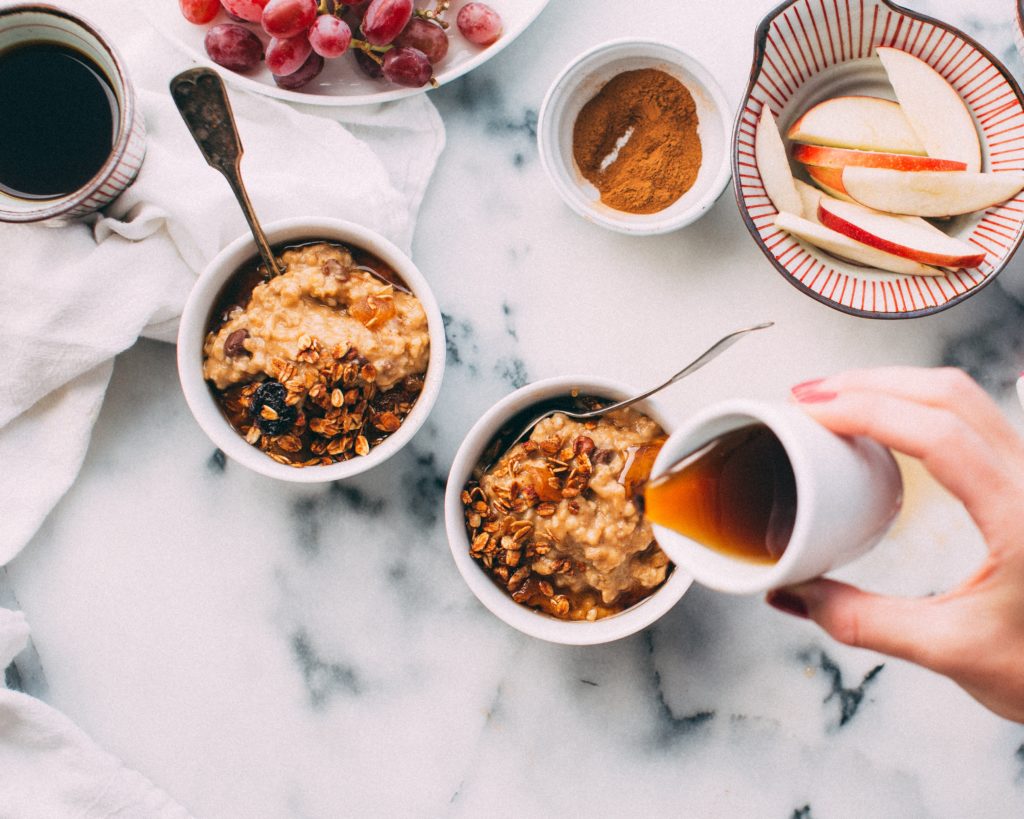
Serves 2
1 cup blueberries (fresh or frozen)
1 cup oats (gluten-free)
1 cup almond milk
1 tablespoon chia seeds
2 tablespoons hemp seeds
½ teaspoon cinnamon
1 banana, sliced
¼ cup chopped walnuts
- Blend blueberries in the food processor until smooth.
- Mix blueberries, oats, almond milk, chia seeds, hemp seeds in a bowl with a lid. Let set in fridge overnight.
- Split into two bowls and top with cinnamon, banana, and walnuts.
Serve & enjoy!
Tip: Your gut microbes love to eat the fiber in the blueberries, oats, seeds, and nuts. Meanwhile, your brain loves the omega-3 fats in the seeds and nuts.
Ready to explore how food is affecting your mood? Join the FREE 5 Day No Sugar Challange.

References:
http://www.health.harvard.edu/blog/nutritional-psychiatry-your-brain-on-food-201511168626
http://www.hopkinsmedicine.org/health/healthy_aging/healthy_body/the-brain-gut-connection
http://www.precisionnutrition.com/all-about-probiotics
http://www.precisionnutrition.com/fix-gut-fix-health
http://neurotrition.ca/blog/your-gut-bugs-what-they-eat-and-7-ways-feed-them
https://www.scientificamerican.com/article/gut-second-brain/